In this post, I'm trying to piece together the elements of the critique, and to address each of them.
On KCRW's “Left, Right and Center” Adriana Huffington referred to this crisis as a “teachable moment” for the opposition, which should use Katrina as an example to show that radical political change is necessary.
There is no doubt that portions of the Democratic party, the left hive especially, see in Katrina and its aftermath a way to discredit the Administration and promote their own cause. Poll results are contradictory, but suggest at least some short-term damage to the President and his party.
The opposition has croaked out an indictment, which I've tried to summarize here, along with a brief evaluation of each thesis, which generally shows them to be wrong or exaggerated.
1. Global Warming substantially contributed to the disaster by increasing the intensity or frequency of hurricanes.
Not so. Studies appear to show that the number and freuency of hurricanes tends to ebb and flow over the decades. There has not been a substantial increase beyond what has been seen before, correlated with increasing CO2 and other “greenhouse gases” in the admosphere.
2. The Bush Administration's recognition of the Kyoto Treaty was a substntial contributing factor to the hurricane because Kyoto would have had an effect on global warming.
If, for the sake of argument, we accept the proposition that global warming was a factor in the hurricane, it's still true that global warming will continue to increase with or without Kyoto, whose policies won't accomplish much to reverse the course of global warming as most of the scientists who claim GW estimate it.
In short, Kyoto is a toothless tiger, and adopting or not adopting it can have had no effects of GW by 2005.
3. The failure to evacaute New Orleans completely was the Bush Administration's fault.
We have a federal government. Except in times of anarchy or insurrection, the “police power” rests with state and local government. Before Karina hit, there was no condition requiring federal intervention. The local evacuation plan called for the provision of buses for the population that lacked cars, but the pictures of dozens of school buses in flooded lots show that this part of the plan was never implemented. The local authorities were responsible for this one.
4. The failure to evacaute New Orleans completely was a product of racism.
While is is conceivable that a black-dominated administraton could be anti-black, this seems far-fetched. The failure of a fraction of blacks to evacuate voluntarily may be explained by a lack of transportation alternatives to cars, many not having cars, lack of money, lack of education and foresight, and possibly a lack of ties elsewhere.
Although some of these conditions, such as poor education, have a historical connection to racism, the failure of the black and poor to evacuate can't be explained by present racist intent on anyone's part.
5. The Bush Administration was responsible for the abysmal conditions in the Superdome and the Convention Center.
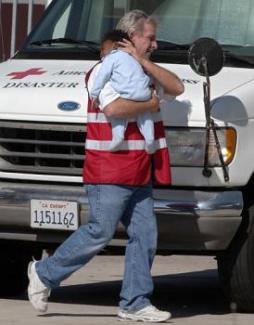
The designation of the Superdome as the shelter of last resort was probably stupid in the first place, but it it was done, one would expect that bedding, water, food, portabile toilets and basic medical care would be made available as part of the plan. Apparently none were, and there are reports that the Red Cross and the Salvation Army were refused permission to provide such amenities.
When the severity of the situation at the Superdome became apparent, at least on Fox and CNN, it appears that all authorities were slow to mobilize to move needed help in and people out.
There was also a failure of self-organization. No one seems to have mobilize the sheltered population to to things like entertain children, dig latrines, move the dead to one location, and haul away trash. It was the “Lord of the Flies” all over again.
6. People died or suffered because President Bush did not interrupt his vacation to return to DC to take charge of the situation.
Certainly the symbolism was bad, reviving the “My Pet Goat” canard. Of course, communications are fine at the ranch, so the practical effect of cutting the vacation short might not be important. The symbolism was terrible, though, for a President who flew back to Washington to sign Terry Schiavo legislation for one non-functioning person.
However, by that time the National Guard mobilizations were under way, so there's no sign that anything was held back during the delay or because of it.
7. The National Guard was too slow to arrive.
It's probably unwise to mobilize much of the guard in the disaster region, where they and their equipment could suffer. Immediately afterward, the guard becan to come in. We don't have a system like the Israelis, where the reserve army is capable of mobilizing almost instantaneously.
8. The National Guard lacked men and resources because they have been diverted to Iraq.
There seem to be plenty of guardsmen, once they got there. No one is complaining of shortages of equipment or men. It's certainly arguable that our military is now too small and stretched too thin for all the assignments that have been given it or are likely in the near future.
Nor have the feds ever been reluctant to increase the deficit in order to finance wars or boondoggles.
9. The Bush Administration is to blame for the looting and disorder that broke out in New Orleans after the disaster.
The police department in New Orleans was small, corrupt, and ineffective. They were in charge, along with some Louisiana guardsman that arrived quickly. Apparently the state and the city decided that rescues were more important than keeping order. Perhaps that was, at first, because looting consisted taking food from closed grocery stores and the like. The result, however, especially when it was announced that nothing would be done about looting, and nothing was, that anarchy began to reign. It's the familiar “broken window” theory of how a neighborhood is lost, highly accelerated.
To make the feds responsible for keeping order, as when Gov. Wilson of California asked the first Pres. Bush for troops during the most recent Los Angeles riots, requires such a request, or an independent Presidential finding that what amounts to insurrection is in process. In a free, federal country, it's understandable that the President didn't do that.
10. It is insensitive and almost sacriligeous to suggest that New Orleans should not be rebuild as it was.
The immediate impulse when a town or city is destroyed is to build it again on the same site in the same plan. When Speaker Hastert questioned whether New Orleans should be rebuilt as it was, he was pilloried. However, there are questions about whether the city can or should be rebuilt as it was.
The year or more that it will take to rebuild the city might also be a year in which both New Orleans business and New Orleans people begin to make new lives of themselves, and many may lose their nostalgia, or be reluctant to uproot themselves, their businesses and their families once again for a questionable future.
The “should we?” question has two aspects—the “Good Samaritan” question and questions specific to New Orleans's location and the attendant costs and benefits of rebuilding.
The “Good Samaritan” question is whether if the government provides disaster compensation for forseeable risks, it encourages risky behavior, such as building towns on floodplains and barrier islands.
The site-specific questions include the following (1) does it makes sense to rebuild a city below sea level where another disaster could wipe it out; (2) would it be economical to rebuild the city with a higher level of flood protection at higher cost? (3) should a smaller city with the essential port and tourism functions be rebuilt? (4) how should it be funded?
The point here is not to analyze some very complex issues— merely that the questions are legitimate ones. As wonderful as New Orleans was in many ways, the costs of building it are “sunk costs”. The question of whether the billions that would be needed to rebuild it, to the extent they come from the taxpayers, could be better spend in some other way, is surely a legitimate one.
UPDATE: Some typos corrected. See some posts and news articles that put FEMA in a bad light here. There's no denying that there was stupidity, incompetence, and pettifoggery on many sides of this thing, which was probably inevitable. But the 10 theses cited above ARE erroneous.