July 9, 2006

Before the Dawn

That's the title of Before the Dawn, a popular but well-researched synthesis of modern research on human origins and prehistory.

It's fascinating to see how much more we know about this stuff than 40 years ago when I first studied it. The most strikingly new information comes from advances in genetics, the analysis of chromosomes and DNA. The notion that Darwinian evolution is mere speculation is knocked into a cocked hat. (What is a cocked hat, anyway?*)

Of greater contemporary interest is the significant evidence that human evolution continues, even over relatively short periods, and that racial differences--accumulated statistically significant genetic diferences in separately breeding populations--are not imaginary, as some politically correct academics would have us believe.

Do these differences negate the common humanity of all people? No.

Are they significant? Yes.

Examples:
  • The emergence of lactose tolerance, that allows adults to digest cow's milk, in the centers of cattle domestication.

  • The emergence of mutations for light skin, at least twice, among northern populations where exposure to sunlight reduces vitamin deficiencies.

  • The emergence of mutations that protect against malaria when one gene is present but cause disease when two are present, again at least twice.

  • The accumulation and persistence of mutations, among Ashkenazic Jews, who were confined to professions that required high intelligence, that are lethal when two genes are present, but in the one-gene form may contribute to high intelligence. This one's still a hypothesis, although the higher IQ of Ashkenazic populations is demonstrated.
Steve Sailer's blog put me on to the book. Sailer has the thick skin required to blog regularly about heredity, race, and intelligence. I often differ with Steve's politics (he's more isolationist and more anti-immigration than I, for example), but he comes up with fascinating stuff, not just on race, but on things like voting patterns (cheaper housing, leading to a higher proportion of married couples with children, is correlated with "red" voting patterns, for example).

The history of the last century or so gives us reason to be chary of simplistic translations into politics of scientific findings and speculations about race, or invocations of science or psuedo-science to justify political views some people already have. And to be doubly chary of any claimed policy implications of this line of inquiry.

There is, however, no doubt that evolution within the human family is still occurring and important inherited statistical differences between populations are real. It may be politically correct to deny it, but it's true. You'd certainly want your doctor to know.

__________
*"Evolved from the bicorne, the black-coloured cocked hat is triangular in shape, with the brim at the left and right sides turned up and pinned together; the front and back ends are pointed; there is usually a cockade in the national colours at the right side. It is often trimmed in gold or silver."

Definition from Wikipedia. Also a picture.

A Sad Death and an Unpleasant Statistic

Columnist Leonard Pitts presents another unpleasant fact, in a poignant column about a sad death:
What should we make of the way 9-year-old Sherdavia Jenkins was playing with her doll last Saturday afternoon? Sherdavia was out in front of her home in Liberty Square, also known as the Pork 'n Beans housing project in inner-city Miami, digging in the dirt. Digging the doll a grave.

Then somebody shot at somebody else -- the who and why are mysteries -- and a bullet pierced the little girl's neck. Today, a week after she played at digging a grave for her doll, Sherdavia will be lowered into one herself.
Unutterably sad.

Pitts goes on to lament that this kind of event is not a big story in the press, and goes on:
In 2004, 14,121 Americans were murdered. Blacks, representing about 12 percent of the nation's population, were 47 percent of the nation's murder victims. Of the 6,632 blacks killed, better than one in four was 21 or younger. Violence is no stranger in certain places.

In those places, kids can tell you what it's like to pass by corpses on the way to school. In those places, the skyscrapers downtown might as well be on another planet. In those places, life is hard and money is tight. In those places, boys walk about with the mean swagger that comes of a gun in the pocket and a conscience on mute, mistaking themselves for men.

In those hard and cold places, death becomes a way of life, a lesson learned young. And then re-learned endlessly. Four days after Sherdavia died, a boy named Markese Wiggan was shot to death in Lauderhill. He was 14 years old.

And so it goes. This is not a black problem. It is, emphatically, an "American" problem. Unfortunately, it is not an American priority.
Pitt does not mention that most of these crimes are committed by other blacks. Of course it's an American problem. These are our fellow citizens.

It's also a black problem, because blacks are pulling the triggers.

I hear not even murmurs of leadership on this issue.

July 8, 2006

We Conjure Leonard Pinth-Garnell

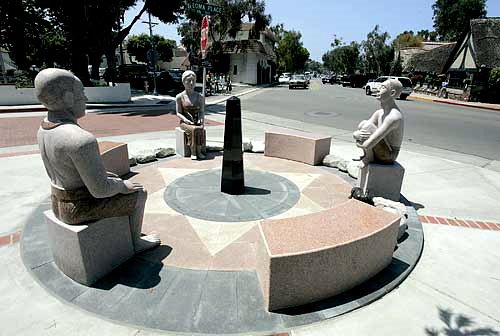
People's Council BoBo Laguna Beach has installed a new public sculpture in front of its City Hall.

Known as "the People's Council," and costing 80 large, it's a subject of controversy.

We conjured the spirit of critic Leonard Pinth-Garnell, who gave the sculpture his nod of approval, and in the course of the séance, offered us these comments:
"Stunningly bad!"
"Monumentally ill-advised!"
"Couldn't be worse!"
"Exquisitely awful!"
"Astonishingly ill-chosen!"
My mother was a sculptor in stone, and there's a lot of work in the piece.

But, say no more, it's public art. Of course, we could have had the Britney piece. Lord, we are grateful for small favors.

The Tinfoil Wimple


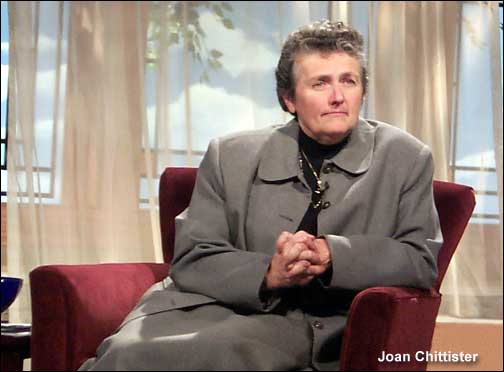
In a Yahoo group I dabble in, someone reposted and praised this article about 9/11 by a Benedictine nun named Joan Chittister. I demurred and referred to an earlier post on this blog about oikophobia, which in turn led to a snark exchange I won't bother to repeat except that I was accused of spouting "talk radio drivel."

Sr. Chittister's piece reminds me just how odd the moonbat fringe of the American Catholic left. I am an admirer of the Anchoress, First Things, and this fine piece on Islam by the Archbishop of Sydney, Australia. There is, however, a visible moonbat fringe among the faithful. Think Christic Institute. Think Berrigan Brothers. Think a trio of clowns from Nukewatch.

Here are my comments, slightly revised from the Yahoo group post:

Since the whole Chittester article is posted, I’ll summarize what I think the article says, and quote portions. Fair enough, I think, because you can check the text to see if I’ve distorted anything she says.

1. Airport Searches.
“We are a country held hostage by fear.”
It's difficult to go through an airport these days [and in foreign
airports there are fewer or less intrusive searches].
COMMENT: Airport security isn’t always well-managed, but we haven’t
had a hijacking since 9/11. Is she saying we should not have airport
security? That it should be managed better? If the latter, I agree.

2. Our Post 9/11 Policies Were Mistaken.
“There's nothing esoteric here. Read the front page of any newspaper and the direction is clear.”
A. What we should have done:
“[W]orking with moderate governments and the world community . . . of courting public opinion and international support, . . . trying to understand the U.S. image around the world and working to change it, . . . asking why gleeful children danced in the streets when the Twin Towers fell, . . . doing something positive to correct it . . “
COMMENT: (1) Fundamentally, she’s arguing that 9/11 was our fault, we provoked the attack, and we should appease our attackers, or at least their sympathizers.

(2) The US has achieved a fair amount of cooperation on anti-terrorism activity, even from places like France whose governments repeatedly bad-mouth the US.

(3) There is no “world community.” There is the UN, which is a corrupt cartel of tyrants, not a community. There are countries, and each is different.

(4) Our society, at least the policy-conscious part of it, has spent a lot of energy trying to understand Islam and Islamic radicalism--go to any bookstore.

(5) The notion that we are responsible for the attacks on us is only true to a very limited extent. People who want to restore the Caliphate and restore Andalusia to Muslim rule (Bin Laden), or evoke the return of the 12th Imam (Ahmadinejad), are not just upset because of one or another US policy. If we did everything they asked, they’d take it as a sign of weakness and keep on with their program. If we resist, the use our resistance to justify jihad.

B. What we did:
“We did the frontier thing and began to kill people ourselves. As in "That'll show ' em who's boss."
COMMENT: Well, yes. Afghanistan harbored the people who killed more Americans than at Pearl Harbor, and destroyed an important part of our largest city. They wouldn’t give them up. Act of war. A military response was appropriate.

Reasonable minds can differ about the wisdom of the Iraq War. We did, however, take out some really bad people, and we are fighting some really bad people. The author’s purpose is not to provide an answer. I don’t think those who think as she does have any good ones.

3. A. The U.S. has provoked terrorism and nuclear arms ambitions of Iran, Korea, and Pakistan.
“By defining the attack on the Twin Towers as the declaration ofglobal war, it has made global war a reality . . .”.

“By launching high technology weapons against countries whose armies are under equipped and whose borders are porous, we have even managed to reinstitute a nuclear arms race. Iran, Korea, and Pakistan have all joined the new race out of fear of what might happen to them . . . in the future.”
COMMENT: The modern war of Islam against the West has been going on for a while--at least since the Iranian embassy event. The difference is that after 9/11, for the first time, we began to fight back.

Iranian, Korean and Pakistani nuclear programs and ambitions preceded 2001. Pakistan was responding to India, not the US. North Korea is the last, horrendous avatar of Stalinism and has its own regional agenda
.
B. Iran, Korea and Pakistan are not evil and do not need regime change
“ . . . our unilateral decree that they are evil and in need of regime change.”
COMMENT: I submit that Iran and North Korea can accurately be described as evil. They are not an “axis,” as Bush suggested. Régime change in each is desirable. Pakistan is complex, but a person who believes in state redistribution of wealth, such as the author, not to speak of religious freedom, might well have issues with Pakistan, too.

What (if anything) the US should do to achieve such change is an open question. It may be that watchful waiting is the best policy.

4. The US is a Torture State.
“So we fight in the dark everywhere, claiming thousands of innocent lives and few "terrorists." We do it against those who claim no flag, no government, no terms of peace, and we may never know if we have managed to defeat them or not.

“While old ladies and small children go on forever removing their jackets and shoes and cell phones in U.S. airport security lines, the United States has been exposed as a torture state.

“The government refuses to submit its military behavior to an International War Crimes Tribunal and so, as far as the rest of the world is concerned, admits that its behaviors are in question.”
COMMENT: Yes, this is a twilight, ambiguous struggle. So be it.

The US as “torture state” is an overheated exaggeration. Torture states do not try their soldiers for misconduct, allow their courts to instruct the executive on the limitations of its prerogative, or pass bills outlawing torture. Have prisoners been mistreated? Yes. Is some of the executive complacent about this? Yes. Is that a legitimate concern. Yes. But “torture state” is overheated rhetoric.

There are good reasons not to trust an International War Crimes Tribunal, and some good reasons to do so. Personally, I think the author’s crush on international institutions and the “world community” is misguided and a symptom, precisely, of oikophobia.

5. 9/11 Was Done by 19 Independent Fanatics.
“And all of this on account of 19 politically independent, unauthorized fanatics.”

Fanatics, yes. Inspired by an ideology, and directed by a network, sheltered by a state actor (Taliban Afghanistan). The political movement in question has neither disappeared nor been defeated.


6. We Are Fighting the Wrong People and Haven’t Prevailed Yet.
“They provoked from us an all-out irrational response against the wrong people . . . “

“Meanwhile -- has anybody noticed -- Osama bin Laden is still free somewhere and sending us tapes? The Taliban have returned to Afghanistan. Millions of civilians have either left Iraq, are internal refugees in their own country or have been killed there in order to protect them.”
COMMENT:This struggle is a long, twilight struggle. True, we haven’t won yet, but that doesn’t make the struggle unworthy. The article, however, is not a tactical or strategic critique, which, if thought out, would be welcome.

Rather, it implies we should not be fighting at all. I disagree, as do most Americans.

7. We Are Losing the Constitution.
“And here, in the United States, paranoia grips the land. The
Constitution is being shredded one line at a time.”
COMMENT: As in every war, there is a tension between civil liberties and what is thought to be military necessity. But the Constitution shredded? Blatant hyperbole.

8. War Spending Has Prevented the Enactment of More Welfare State
Policies, Which Are Good Things.
“We are facing a decade-long moratorium on social issues . . . universal medical insurance, day care services, subsidized housing or welfare programs, and the army is where the young go to get an education.”
COMMENT: This is not the place to debate these welfare state issues. Social spending, especially education spending is actually up, although much is wasted due to the teachers’ unions and the educationists. There has been no decline, post 9/11, in any of this.

And in fact, the country, wisely, has not voted for high-tax, redistributionist social reforms. Many of these proposals are in fact dangerous to the economy, to liberty, and to good morals. Read Theodore Dalrymple, for example.

9. We Should Have Responded Differently, But I’m Not Saying How.
“From where I stand, it isn't that 9/11 did not demand a response. It's that the response we made has the smell of inanity.”
COMMENT: I know the purpose of the article was not to propose alternative policies, although these are implied (make concessions to the Islamist program, bend the knee to one or another supranational organization, enact massive social welfare programs, take no military action even against those who harbored the organizations that attacked us).

Was our response perfect? No, far from it. Would the opposition have done better? I doubt it. Is there more we can do. Yes.

GENERAL COMMENT: In its hyperbolic language about every flaw in US conduct, its unwillingness to present an analysis of Islamist terrorism other than to say generally US policy provoked it, in its alarmism (for instance, about the shredded and presumably about to be stir-fried Constitution), and in its deference to supranational institutions, Sr. Chittister's article is an example of oikophobia.

July 6, 2006

Rebecca West's Advice to Girls

From Black Lamb and Grey Falcon (1941).:
Remember, when the nuns tell you to beware of the deceptions of men who make love to you, that the mind of man is on the whole less tortuous when he is love-making than at any other time. It is when he speaks of governments and armies that he utters strange and dangerous nonsense to please the bats at the back of his soul. This is all to our disadvantage, for in love-making you might meet him with lies of equal force, but there are few repartees that the female governed can make to the male governors.
Here West is referring to courtship rather than to the physical act of love. Never believe anything a man says when he is horizontal.

July 5, 2006

Health Care Proposals

Dr. Bob, a Seattle urologist with a fine blog, has a few suggestions for improving the health care mess.

His whole series is thoughtful, grounded in experience and compassion, and worth reading.

July 4, 2006

Trust the American Street

Says Hitch, and stop worrying about the %$#@#* polls.

The Nation's loss is our gain.

Oikophobia


Xenophobia is a well-known term, from the Greek xenos meaning "foreign" and phobia meaning "fear" or "aversion." It is unfashionable and regarded as politically incorrect, and is one of the accusations hurled at, say, those who want to limit immigration.

The English philosopher and writer Roger Scruton has given a speech in which he provides a new definition for the opposite of "xenophobia"--oikophobia. Oikos means "house" or "household" in Greek, and hence is one of the roots of the word "economics"--the law of households.

"Oikophobia" is sometimes used, apparently, as the opposite of "agoraphobia," the latter being a fear of the agora or market, and thus crowds or open places. "Oikophobia" in this sense is fear of being at home.

Scruton means something quite different. It is systematic hostility to one's home, country, or tradition. It has long been common in this country, and in South America, among those, especially the élite and the wealthy, who used to look to Europe and especially to France, for all things classy and cultural.

Oikophobia has evolved, in the West, into a disdain, nay, hatred, of all things American in America, British in England, and so on. Consider the lefty singer Billy Bragg's Take Down the Union Jack:
Take down the Union Jack
It clashes with the sunset
And put it in the attic
With the Emperor’s old clothes

When did it fall apart ?
Sometime in the 80’s
When the good and the great
Gave way to the greedy and the mean
It's a constant search for cultural novelty and a rejection of the ways and traditions of one's own country.

Scruton's whole speech on the subject is worth a read, but here's an excerpt:
When Sartre and Foucault draw their picture of the ‘bourgeois’ mentality, the mentality of the Other in his Otherness, they are describing the ordinary decent Frenchman, and expressing their contempt for his national culture. A chronic form of oikophobia has spread through the American universities, in the guise of political correctness, and loudly surfaced in the aftermath of September 11th, to pour scorn on the culture that allegedly provoked the attacks, and to side by implication with the terrorists. And oikophobia can be everywhere read in the attacks levelled against the Vlaams Belang [the Flemish independence party in Belgium].

The domination of our national Parliaments and the EU machinery by oikophobes is partly responsible for the acceptance of subsidised immigration, and for the attacks on customs and institutions associated with traditional and native forms of life. The oikophobe repudiates national loyalties and defines his goals and ideals against the nation, promoting transnational institutions over national governments, accepting and endorsing laws that are imposed from on high by the EU or the UN, and defining his political vision in terms of cosmopolitan values that have been purified of all reference to the particular attachments of a real historical community. The oikophobe is, in his own eyes, a defender of enlightened universalism against local chauvinism.
We find it in the jurisprudence of our Supreme Court, where Justices Ginsburg and Breyer have seen fit to use foreign law to interpret our own Constitution, and in the fetishization of that cartel of tyrants, the United Nations, seen not as a rather corrupt and inefficient forum with a few decent programs and a few practical uses, but as a kind of collective Messiah.

The great poet Kenneth Rexroth, who was a kind of eco-anarchist, coined the term "Crow-Jimism." "Jim Crow," of course, was a name given to the system of legal racial segregation in the American South. "Crow-Jimisim" was the tendency, among the left and the literati, to worship uncritically everything thought to be Negro (the PC term, back then). Usually folks afflicted by this ailment had an unreal and romanticized notion of the Negro. This, too, is a kind of oikophobic pathology.

Oikophobia in part is the product of that ancient snobbism that looked to Paris and London for everything classy. It is in part a transformation of criticism of one or another policy of the government into a disdain for the whole society. And it is in part an expression of the big-city intellectual's sense of superiority to the rubes.

It's one reason for the contempt for George W. Bush as a person, that predates both 9/11 and the Iraq war. Bush seemed too American, too down home. Anyone like that must be an idiot, a Babbit, a zombie transfixed by the Elmer Gantrys of the world, part of the "booboisie," as Mencken put it. Better the cookie-pushing Adlai Stevenson than the flat-speaking Dwight Eisenhower. Better the incomprehensible self-indulgence of the nouvelle vague French and Italian cinéastes than Ford or Huston. Even the Dixie Chicks don't just disagree with the Iraq war, they're ashamed to be American.

Oikophobia is a disaster. If you want to change this country, and we all do, in one way or another, you can't despise it, but should learn to love it, to own it as part of oneself. Understand the national idea and the national tradition--there's much in it to love. If you want change, don't dream the dreams of Sartre and Foucault and Howard Pinter. Dream the "patriot's dream."
O beautiful for patriot dream
That sees beyond the years
Thine alabaster cities gleam
Undimmed by human tears!
America! America!
God shed his grace on thee
And crown thy good with brotherhood
From sea to shining sea!


And read "The Man Without a Country."

UPDATE: This piece on "transnationalism" makes a similar case in more detail. It's worth a read.

Words For the Fourth From Not-Always-Silent Cal

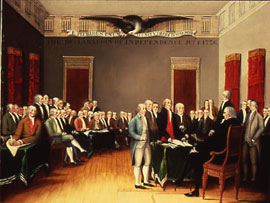
Signers of the DeclarationIn honor of the Fourth, PowerLine quotes from a speech by Lincoln in the famous debates by Douglas.

They also quote from the underappreciated Calvin Coolidge's speech on the occasion of Independence Day.

Here's a sample:
On an occasion like this a great temptation exists to present evidence of the practical success of our form of democratic republic at home and the ever-broadening acceptance it is securing abroad. Although these things are well known, their frequent consideration is an encouragement and an inspiration. But it is not results and effects so much as sources and causes that I believe it is even more necessary constantly to contemplate. Ours is a government of the people. It represents their will. Its officers may sometimes go astray, but that is not a reason for criticizing the principles of our institutions. The real heart of the American Government depends upon the heart of the people. It is from that source that we must look for all genuine reform. It is to that cause that we must ascribe all our results.

It was in the contemplation of these truths that the fathers made their declaration and adopted their Constitution. It was to establish a free government, which must not be permitted to degenerate into the unrestrained authority of a mere majority or the unbridled weight of a mere influential few. They undertook the balance these interests against each other and provide the three separate independent branches, the executive, the legislative, and the judicial departments of the Government, with checks against each other in order that neither one might encroach upon the other. These are our guaranties of liberty. As a result of these methods enterprise has been duly protected from confiscation, the people have been free from oppression, and there has been an ever-broadening and deepening of the humanities of life.

Under a system of popular government there will always be those who will seek for political preferment by clamoring for reform. While there is very little of this which is not sincere, there is a large portion that is not well informed. In my opinion very little of just criticism can attach to the theories and principles of our institutions. There is far more danger of harm than there is hope of good in any radical changes. We do need a better understanding and comprehension of them and a better knowledge of the foundations of government in general.
A wise man, old Cal.

For some patriotic songs, go here and here. For more on Silent Cal, try this.

And be sure to eat some solid food.

UPDATE: Here's the Concord Hymn, by Longfellow:
CONCORD HYMN

Sung at the Completion of the
Battle Monument, July 4, 1837

By the rude bridge that arched the flood,
Their flag to April's breeze unfurled,
Here once the embattled farmers stood,
And fired the shot heard round the world.

The foe long since in silence slept,
Alike the Conqueror silent sleeps,
And Time the ruined bridge has swept
Down the dark stream which seaward creeps.

On this green bank, by this soft stream,
We set to-day a votive stone,
That memory may their deed redeem,
When like our sires our sons are gone.

Spirit, that made those heroes dare
To die, or leave their children free,
Bid Time and Nature gently spare
The shaft we raise to them and Thee.

July 3, 2006

Lying Sack

Patterico provides a summary of work by various bloggers, fisking Eric Lichtblau of the New York Times's "it's not a betrayal of secrets because everyone knew about it" revisionism.

Patterico, a prosecutor, has this advice for Mr. Lichtblau:
Hint for Mr. Lichtblau: when they get you under oath, you’ll be much better off if the lies are less obvious than this.
If Mr. L. is wise, that word should be sufficient.

July 2, 2006

Playing Descartes You Were Dealt

An insomniac Googling dredged up the following:
René Descartes is sitting in a café not far from the the intersection of Faith and Culture.

He’s just finished a cup of his favorite Surabaya Johnny Half-Caf Arabica-Cappucino Blend.

The waiter asks him if he’d like another.

Descartes says, “I think not.”

And he disappears...
HT: On Coffee.

July 1, 2006

Yadda yadda

NY Times editor Bill Keller and LA Times editor Dean Baquet have published a joint defense of their publication of secret national security information. It's cliché-ridden and shallow. I'll spare you the tedium--you can go read it yourself if you like, but here's the coda:
We understand that honorable people may disagree with any of these choices — to publish or not to publish. But making those decisions is the responsibility that falls to editors, a corollary to the great gift of our independence. It is not a responsibility we take lightly. And it is not one we can surrender to the government.
In short, we're wiser than the professionals our elected leaders have chosen.

If you commit a crime, though, like publishing classified information, the government plus a jury of your peers may get to second-guess you. And in a free country we get to fisk both Timeses, and with talk radio and the blogosphere we have the media to do it.

How about a special prosecutor here? Seems a lot more important than Valerie Plame and her creepy husband.