October 8, 2006

Poland--Fencing!

There was an ethnic joke at the time of the 1984 Olympics. A black, a Mexican, and a Pole are moping outside the stadium because they don't have tickets. The black guy strips to his shorts, steals a hubcap, and runs in saying "Kenya, discus!" The Mexican grabs an auto radio antenna, and runs in saying, "Mexico, javelin!" Our stereotyped Pole grabs some barbed wire and runs in saying, "Poland, fencing!"

If Mickey Kaus's fears are right, Pres. Bush's first veto (a pocket veto) might be of the legislation providing for 700 miles of border fence. Given that bureaucratic maneuvers already threaten to reduce that law to an unrealized expression of sentiment, such a veto would be the ultimate betrayal of the base. The fence law is the product of authentic grass-roots sentiment. If Bush, who has never picked up a veto pen, chooses this modest security measure, dear to the hearts of many ordinary people, many will wonder what the point is of maintaining GOP control of the House.

A party that ignores pederasty and an insecure border inspires little confidence. I think Nancy Pelosi and her minions will be worse, but how much worse can they be, if Bush realizes he can use the veto pen.

October 7, 2006

An Officer Mourns For His Dead Horse

Lamento do oficial por seu cavalo morto

Nós merecemos a morte,
porque somos humanos
e a guerra é feita pelas nossas mãos,
pelo nossa cabeça embrulhada em séculos de sombra,
por nosso sangue estranho e instável, pelas ordens
que trazemos por dentro, e ficam sem explicação.

Criamos o fogo, a velocidade, a nova alquimia,
os cálculos do gesto,
embora sabendo que somos irmãos.
Temos até os átomos por cúmplices, e que pecados
de ciência, pelo mar, pelas nuvens, nos astros!
Que delírio sem Deus, nossa imaginação!

E aqui morreste! Oh, tua morte é a minha, que, enganada,
recebes. Não te queixas. Não pensas. Não sabes. Indigno,
ver parar, pelo meu, teu inofensivo coração.
Animal encantado - melhor que nós todos!
- que tinhas tu com este mundo
dos homens?

Aprendias a vida, plácida e pura, e entrelaçada
em carne e sonho, que os teus olhos decifravam...

Rei das planícies verdes, com rios trêmulos de relinchos...

Como vieste morrer por um que mata seus irmãos!

(in Mar Absoluto e outros poemas: Retrato Natural. Rio de Janeiro, Nova Fronteira, 1983.)


An Officer Mourns For His Dead Horse

We deserve death
because we are human
and make wars with our hands
with our heads wrapped in centuries of shadows
with our strange and unstable blood, with the orders
we carry inside us, which remain without explanation.

We create fire, speed, the new alchemy,
the calculated gestures,
even though we know we are brothers.
Even atoms are our accomplices, and what sins
of science, at sea, in the clouds, even among the stars.
What madness without God, our imagination!

And here you died! Your death is mine, which, by mistake,
came to you. You don't complain. You don't think. You don't know. I'm outraged
to see your harmless heart stop for mine.
Enchanted animal--better than all of us!
What did you have to do with this world
of men?

You learned to live, quiet and pure, intermingled
flesh and dreams that your eyes deciphered . . .

King of the green plains, trembling rivers of whinnies . . .

How did you come to die for one who kills your brothers!

--Cecília Meireles (Absolute Sea and other poems, Rio de Janeiro, 1983

A Butterfly Passes Before Me

Passa uma borboleta por diante de mim
E pela primeira vez no Universo eu reparo
Que as borboletas não têm cor nem movimento,
Assim como as flores não têm perfume nem cor.
A cor é que tem cor nas asas da borboleta,
No movimento da borboleta o movimento é que se move,
O perfume é que tem perfume no perfume da flor.
A borboleta é apenas borboleta
E a flor é apenas flor.

--Alberto Caeiro
A butterfly passes before me
And for the first time in the Universe I notice
That butterflies have neither color nor movement,
Just as flowers have neither aroma nor color.
It's color that has color in the butterfly's wings,
In the movement of the butterfly it's movement that moves,
It's aroma that gives off an aroma in the aroma of a flower.
A butterly is just a butterfly
And a flower's just a flower.


Discuss amongst yourselves, whilst I pour myself a dram. It's alcohol that's alcohol in a spot of Scotch. Whiskey's just whiskey.

Secret Recall?

It appears that Albert's cornmeal has been recalled from all the local supermarkets, but we can't figure out why, and there's nothing about it on Google news.

Does anyone have any idea what's up?

Russia and Georgia

Russia's Putin régime, miffed by the reckless uppitiness of the Georgians (Georgia-Tbilisi, not Georgia-Atlanta), is cracking down on the Georgians who live in Moscow and other places in Russia. This includes deporting some in summary fashion and asking schools for lists of pupils with Georgian surnames so their immigration status may be investigated.

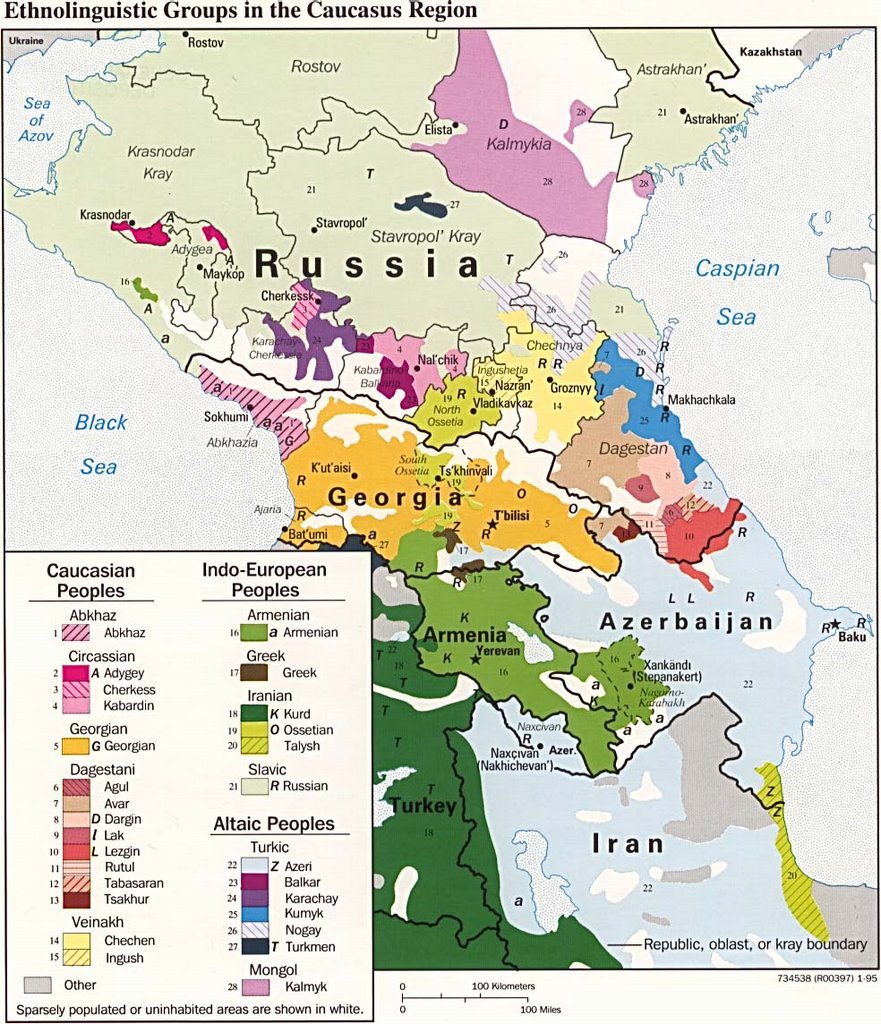
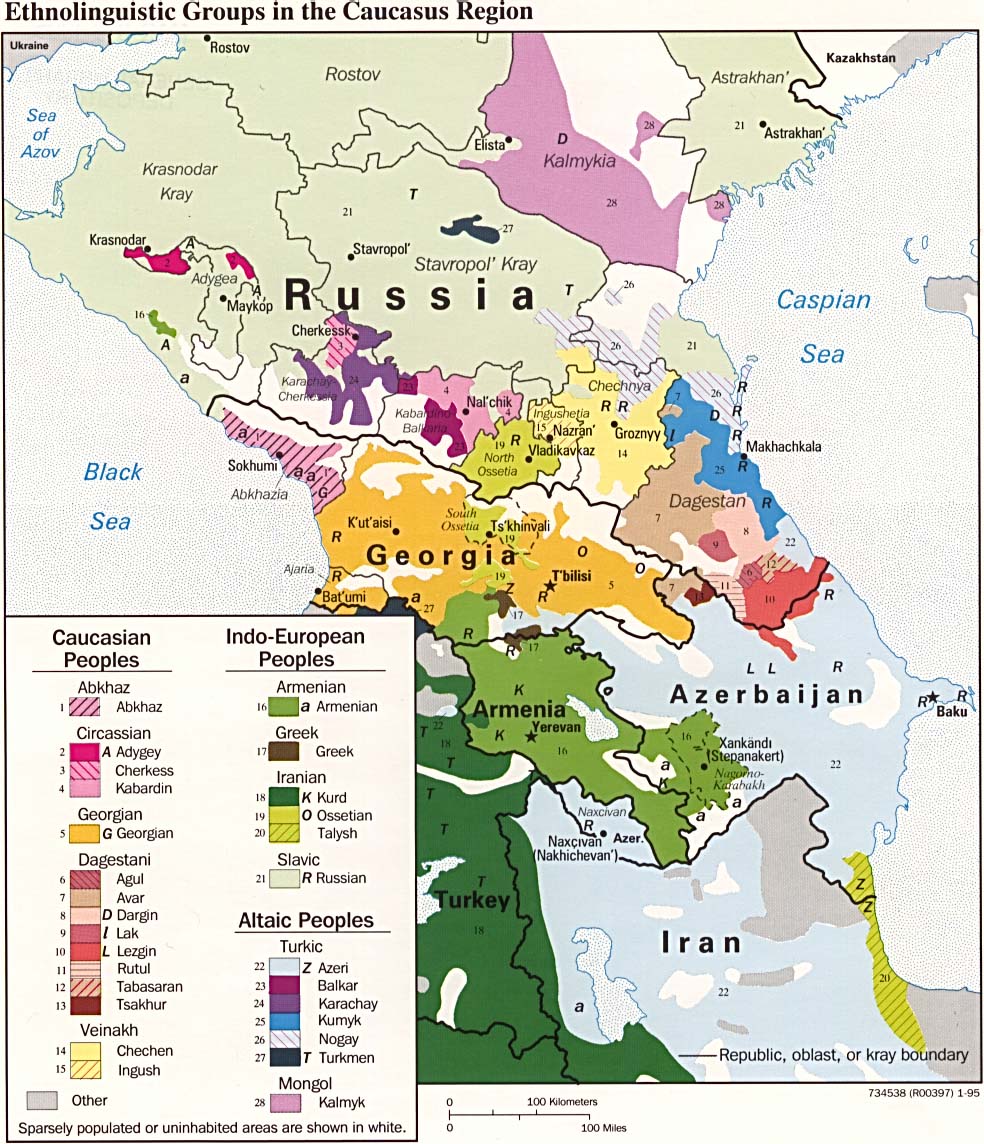
Aside from its injustice, and the lack of respect for another Orthodox people, this policy seems risky to me. The Russian Federation is no longer a federation, and is far from wholly Russian, as this ethnic map of the Caucasus and nearby Russia shows (much larger original here). A too-hostile attitude toward ethnic minorities could create more Chechnya-like problems among the various minorities.

The Georgians, too, are playing with fire by arresting Russian officers as spies. Russia could crush them if it chose, at some cost to its international reputation, and if it did so, it would be with the usual mixture of brutality and incompetence, as displayed in Afghanistan and Chechnya.

Optimism is not warranted. Homo homini lupus.

See Larison's more erudite and impassioned take on these events.

UPDATE: More from the prolific Larison in this post. He's the only guy I know who would back up a statement about the affinity of Armenia and Georgia with a reference to an Armenian bard who was once court poet in Tbilisi. It could have been a thousand years ago, but to L. it's as if it were yesterday.

October 4, 2006

Broken

With all the foofaraw about Rep. Chickenhawk, we should remember a far more serious and far more somber event, the murder of Amish schoolgirls in Pennsylvania. These are different people:
PARADISE, Pennsylvania (CNN) -- A grieving grandfather told young relatives not to hate the gunman who killed five girls in an Amish schoolhouse massacre, a pastor said on Wednesday.

"As we were standing next to the body of this 13-year-old girl, the grandfather was tutoring the young boys, he was making a point, just saying to the family, 'We must not think evil of this man,' " the Rev. Robert Schenck told CNN.

"It was one of the most touching things I have seen in 25 years of Christian ministry."

The girl was one of 10 shot by Charles Carl Roberts IV after he invaded their one-room schoolhouse in rural Pennsylvania on Monday.
I couldn't say that. Perhaps I should, but I couldn't.

HT: Rod Dreher, who writes:
Could you do that? Could you stand over the body of a dead child and tell the young not to hate her killer? I could not. Please God, make me into the sort of man who could.
I'm not even certain I'd want to be that way. As I say, perhaps I should.

UPDATE: Here's a fascinating piece by a rabbi outlining the difference between the Jewish and Christian atttitudes toward forgiveness vs. hatred of evil.

If True, This is Disgusting

Stop the ACLU alleges that the Westboro Baptist Church, which has been picketing the funerals of American servicepeople, claiming that their deaths are punishments for the toleration of homosexuality, plans to picket the funerals of the little Amish girls so tragically murdered in Pennsylvania.

That's bad enough, but according to the website's report the ACLU is opposing legislation to create buffer zones around funerals.

Suspicious minds would say that these militant secularists would want to protect the most disgusting possible example of religious expression.

Maybe I'm naïve, but somehow I think we can have the First Amendment and a decent respect for the bereaved and the deceased.

Nor would I weep if someone tarred and feathered these creeps and ran them out of town on the proverbial rail.

Iraq Revisited

I've been reading and commenting on a remarkable blog maintained by one Daniel Larison, of all things a graduate student in Byzantine studies at Chicago. He's astoundingly prolific, a good writer, quite erudite, and his opinions emerge from no cookie-cutter I'm familiar with.

Larison's some a kind of paleo-conservative, but an unusal kind. Among other things, he is strongly opposed--on principle--to the Iraq war and to interventionism generally.

He posted here on Daniel Linker's vanishing blog, and then turns to Victor Davis Hanson, whom I defended in a comment. Larison also went into a long riff on what he regards as inconsistent latecoming opposition to the Iraq war based upon things like Administration incompetence, rather than a fundamental disagreement about the underlying rationale for the war. It's a long post, so I'll follow fair use and just supply an excerpt:
When people say that so-and-so was on the wrong side of history, this invariably means that he was on the losing side of a war or a revolution, and when they say “wrong” side they usually mean it very much in terms of moral judgement. This is what it means 95% of the time it is used. Likewise, when your ideas are allegedly consigned to the “dustbin of history,” it is almost always because you lost a war. Wars, in this view of history, prove the supremacy and value of some ideas over others. This is simply untrue, but it does help explain why people who believe this–or at least talk as if they believe this–are perfectly happy to endorse wars for ideological causes, because they are already convinced that winning wars will vindicate and “prove” their ideas right. Incidentally, that is why there are so many on the left and nominal right emphasising incompetence as the central flaw of the administration. While real, dissident conservatives have stressed the evils of the administration’s ideological tunnel vision, incompetence has been the buzzword for all of the former war supporters who have since seen the light. The script goes something like this: intervening militarily to democratise rogue states and enforce nonproliferation regimes is more or less a good solution, but this crowd has simply screwed it up too badly. There are also those who are zealous war supporters but who focus on administration incompetence as a way of exculpating the ideas tied to the war–democratisation, interventionism, preemption, etc.–from the judgement that they think defeat in war imposes on whether ideas are sound or not. Four out of five times these days when you find a born-again war opponent, he will cite his support for the principle of doing what we did in Iraq but will also lament the poor execution. This is rather like the wisdom of the man who says, “If only I had been allowed to drive the car off the cliff, we wouldn’t have crashed.”
It seems to me, first of all, that incompetence is a legitimate reason to reverse ground on the war. In determining whether a war is just, one consideration is the likelihood of success. It is morally more questionable to kill and be killed on fool's errand than where success to a just purpose is likely.

So if one such as I who supported the war (warily) at first had known that there was either no planning or bungled planning for the aftermath, and how ignorant the US government was about Iraq, the conclusion would be that achieving the desired result was unlikely, and accordingly that the war would be neither just nor wise. This strikes me as a legitimate set of second thoughts.

Larison, however, would go deeper. He is opposed to the use of force to effect changes like democratization, which I take it he believes both wrong and ineffective. I suspect he is one who opposes foreign entanglements generally. Perhaps, like me, he thinks our entry into World War I was a tragic error.

I sympathize with this view. I have always thought Woodrow Wilson a liar (he campaigned in 1916 as one who had avoided war, even while planning to enter it), and with the slogan of "making the world safe for democracy" unleashed genies that have still not reentered the bottle. Once the Soviet Union collapsed, I saw no reason for keeping NATO, let alone expanding it, and would have brought our troops home from Europe, and considering how unwelcome they now seem to be, from places like Korea.

This orientation, which I share with Larison to some extent, does not exhaust the issue. After the World Trade Center and the Pentagon were attacked, it became clear that there was a jihadi movement sheltered in Afghanistan. When the Taliban government of that country refused to expel or turn over Al Qa'ida, there was a legitimate casus belli. The jihadi movement, however, had echoes throughout the Muslim world and had been proven to constitute a danger.

Given that American soil had been attacked, we had reason to assess where else danger of attack lurked in the Muslim world. Iraq fit into a suspect category. Not only was Saddam an unusually bloody tyrant, he had attacked a neighbor, used chemical weapons on his own people, engaged in a protracted war with a another neighbor (Iran) and in the past was known to have developed chemical weapons and attempted to develop nuclear weapons. Although Iraq was an artificial creation, it had an educated middle class. The idea that Saddam could be deposed and a régime might emerge that would be a catalyst for change in the Middle East, although fraught with risks, had some strategic appeal, and if Saddam really had WMD, a successful assault had additional justification. Although an alliance between Saddam and Al Qa'ida seemed improbable, Saddam had harbored terrorists such as Abu Nidal, and had every reason to be hostile to the United States.

All of this made me guardedly favorable to the war, in spite of my genrally skeptical view of armed utopianism and foreign entanglements not motivated by a global threat such as communism.

What few knew was that although régime change was on the lips of the war advocates, it was not thought out in the war plans. In fact, if Thomas Ricks's Fiasco is credited, Defense Secretary Rumsfeld actively discouraged such planning.

That, combined with the hyping of an Iraqi WMD program that turned out to have been abandoned, and the tenuous nature of the evidence of cooperation between Saddam and Al Qa'ida, left the only remaining justification for the invasion--the incredible brutality of Saddam's régime--weakened by the war planners' failure to answer question "What do we do now (that we've taken Baghdad)?"

Moving forward to October 2006, what is the answer to the question, "Now that we are in Iraq, what do we do next?" I haven't heard very good answers to that question from anyone.

October 2, 2006

We Are No Longer Led By Men

Kleinhelder on pederasty in Congress and beyond:
And don't think Foley is alone in the Republican ranks either. Not just politicians but professional conservatives. Spokesman and leaders who get on TV talk tough, spout conservative positions, and then get in their cars and cruise for young boy prostitutes. It happens. More frequently than you think.

The question is: why?

Many reasons, I suspect, but I believe it is very much the same as the reasons why sexual misconduct is so prevalent in the clergy.

Social conservatives come in two flavors. The first are the authentic religious converts and those who were reared with conservative values who did not rebel.

Then there is a second category. Those who are trying to fix themselves through their faith and/or ideology. Nominal conservatives, who have a sickness and are trying to self medicate. They know what they do is wrong, they know they have a problem.

They think, maybe, if they stand with those who are "right" and "moral", if they mouth the words enough, they will be cured. They hope that they will no longer do those dirty little deeds that their impulse control will not combat.

Seldom works though.

This is the dilemma for social conservatives. We live in a disconnected and non-judgmental society. People, more or less, mind their own business and stay out of other people's crap. This is part of the reason that the cover-up went on for so long.

Everybody knew, up on the hill, that Foley was not what he projected himself to be. Everybody knew he was gay and everybody knew that he hit on young boys.

But nobody wanted to pull the trigger on him. No body wanted to up in anyone's grill. Absent a specific complaint being pushed by someone, the movers and shakers on the Hill were content to let this thing take its course.

Hastert and the Republicans that knew about this should be taken to the woodshed but don't for one minute think that this is a Republican or Democrat thing. Republicans had specific knowledge sure but everyone in that body either knew or heard about how Foley was to one extent or another. They did nothing because we, in Modern America, are no longer our brothers' keepers.

Not that we should be in everybody's business, but this is Congress. A body of leaders.

Yet with all the rumors and the actual reports of pederasty by Foley no one stepped up and put a stop to it. This is not only a failing of the Republican Party leadership and of social conservatism generally, it is a society-wide failing.

We are not as close-knit a community anymore and we are no longer led by men. Everyone is free to do their dirty little deeds and everyone is more than happy to look the other way and no one has the fortitude to call anyone on their actions."
In other words, for some it's a "Stop me before I kill again" scenario.

HT: Daniel Larison.

"Campaign Finance Reform"=Censorship

George Will has a column today detailing the increasing use of "campagin finance reform" statutes and rules as a means of supressing and punishing speech on political subjects. It's chilling. In addition to the prosecution under CFR laws in Seattle of two talk-radio hosts who promoted a ballot measure against a gas tax increase, Will reports the following:
A few people opposed to a ballot initiative that would annex their neighborhood to Parker, Colo., talked to neighbors and purchased lawn signs expressing opposition. So a proponent of annexation got them served with a complaint charging violations of Colorado's campaign-finance law. It demands that when two or more people collaborate to spend more than $200 to influence a ballot initiative, they must disclose the names, addresses and employers of anyone contributing money, open a separate bank account and file regular reports with the government. Then came a subpoena demanding information about any communications that opponents of the initiative had with neighbors concerning the initiative, and the names and addresses of any persons to whom they gave lawn signs. They hired a lawyer. That has become a cost of political speech.

In Florida, a businesswoman ceased publication of her small-town newspaper rather than bear compliance costs imposed by that state's speech police. Even though the Wakulla Independent Reporter contained community news and book reviews as well as political news and editorials, state campaign regulators declared it an "electioneering communication" in league with certain candidates, and ordered her to register with, and file regular reports to, the government.

This is the America produced by "reformers" led by John McCain. The U.S. Supreme Court, in affirming the constitutionality of the McCain-Feingold speech restrictions, advocated deference toward elected officials when they write laws regulating speech about elected officials and their deeds. This turned the First Amendment from the foundation of robust politics into a constitutional trifle to be "balanced" against competing considerations—combating the "appearance of corruption," or elevating political discourse or something. As a result, attempts to use campaign regulations to silence opponents are becoming a routine part of vicious political combat.

When the court made that mistake, most of the media applauded, assuming, mistakenly, that they would be forever exempt from regulation.
I've never considered myself a free speech absolutist, but campaign finance regulation is already so onerous that lawyers have made it a cottage industry and it's a deterrent to people who would run for office.

Looks like it will get worse before it gets better. It's my biggest beef with John McCain.

October 1, 2006

Annan's Guilt

Captain Ed reproduces part of a London Times story on the retiring Kofi Annan.

It's pretty devastating:
Annan’s term has also been marked by scandal: from the sexual abuse of women and children in the Congo by UN peacekeepers to the greatest financial scam in history, the UN-administered oil-for-food programme. Arguably, a trial of the UN would be more apt than a leaving party.

The charge sheet would include guarding its own interests over those it supposedly protects; endemic opacity and lack of accountability; obstructing investigations, promoting the inept and marginalising the dedicated. Such accusations can be made against many organisations . . .

* * * *

A more specific charge would be that, under the doctrine of command responsibility, the UN is guilty of war crimes. Broadly speaking, it has three principles: that a commander ordered atrocities to be carried out, that he failed to stop them, despite being able to, or failed to punish those responsible. The case rests on the second, that in Rwanda in 1994, in Srebrenica in 1995 and in Darfur since 2003, the UN knew war crimes were occurring or about to occur, but failed to stop them, despite having the means to do so.
One is tempted to ask why we bother.

The Age of Ugliness

Frederica Mathewes-Green writes about religion, films, and life. She recently took a granddaughter to an animated film, Open Season, and observes:
After I took Hannah home, I just felt sad. This is a movie about talking animals, so it can’t be aimed at kids much older than she is. But there wasn’t any element I could honestly say was enjoyable — nothing that sparked wonder. There was lots of skittering and slamming and noise, and the screen often filled up with images that were just plain ugly.

For example, early on the deer wants the bear to promise to be his friend. So he hocks up something slimy and spits it into his hand, then holds it out, dripping, for a shake.

Not much later the deer and bear are lost in the forest, and the bear needs a toilet. He asks the deer, “Well, what do you do?” The deer says, “I don’t know,” and releases a stream of turds.
It's not that Frederica wants spineless goody-twoshoes stuff for children. It's that the world that's mass-produced for them is so ugly:
I inherited a picture book that had belonged to a great-great-great aunt, and inside the covers she’d drawn pictures of beautiful women. I guess girls have always done that, but in her case it was 1870, and the women are wearing ballgowns adorned with tiers of lace, with petticoats and pantaloons underneath. In the 1960’s, I drew women wearing a sheath dress and a mink stole, with hair in a Grace Kelly chignon. Do little girls now draw smirking women with exposed navels and heavy eye makeup? Has “edgy” become the new “beautiful”?

The usual retort is, “So just don’t watch these movies” or “Just don’t buy those dolls.” But you don’t have to buy this stuff; it leaks under the door. American entertainment culture has reached into every corner of the world, and if it’s not in your home, it’s in the home of the kid who sits next to yours in school. If you still don’t think snot is particularly funny, and don’t think it’s a good idea to luxuriate in revenge fantasies, you’re in the minority. This ugly, mean-spirited stuff is mingled with the very air we breathe.

So when I’m leaving the mall with Hannah I’m behind two middle-aged women who are laughing and loudly using the F-word. We pass a guy coming in wearing a t-shirt with an obscene message. Outside, there are obese teenage girls with too much pasty flesh spilling out of too-small clothes, trying to look haughty.

Hannah is a quiet, modest, self-possessed little girl, and unlikely to ever find such things appealing. But I can’t help feeling sorrow that she’s growing up in such an ugly age.
Meanwhile, Michelle Malkin writes about Charlotte Church, who as a teenager was a sweet, talented singer, and coming of age has gone Britney:
The 20-year-old entertainer has rebelled against the wholesome image that brought her fame, fortune and worldwide respect as a rare role model for young girls. She has traded in "Pie Jesu" for "Crazy Chick" — a lousy pop anthem even Ashlee Simpson wouldn't be caught performing. Charlotte's gone from pure-hearted to pure crap. These days, she drinks, she smokes, she curses, she fights, she parties, and she tries very, very hard to shock and offend — like a trashier Lindsay Lohan, only with better pipes.

Charlotte has a new talk show in England, where she plays a profanity-spewing hostess who is part Rosie O'Donnell, part Keith Olbermann (she has bashed President Bush as "clueless" and a "twat") and completely unhinged. The pilot episode featured Charlotte calling Pope Benedict XVI a Nazi, dressing as a nun and pretending to hallucinate while eating communion wafers imprinted with smiley faces (symbolizing the drug Ecstasy). The Catholic News Service reported last month that the pilot also showed Church smashing a statue of the Virgin Mary to reveal a can of fortified wine. To top off her anti-Catholic snit, she stuck chewing gum on a statue of the child Jesus.

The sketch was scrapped from the show's debut, but in the most recent episode aired last week, Church strapped herself to a cross, Madonna-wannabe-style. As one viewer complained in a message quoted by the Daily Mail: "This woman may have had the voice of an angel in the past but now she has the foul mouth of a sewer rat."
It's sad. Decent people have to live in opposition to the culture, which is befouled.

Someone once responded to a comment of mine on another blog words to the effect that conservatives who are determined to defend America are deeply hostile to much of its present-day culture. A paradox, perhaps. But defense means not only resisting attackers, but rot from within.