A Vietnamese-American fellow named Tan Nguyen took on the thankless task of challenging the dimwitted Representative Loretta Sanchez (you remember, she bead Bob Dornan a few years back). Some of his supporters sent out a letter designed to suppress the vote of naturalized Hispanics, stealing the letterhead among other things. Even the local GOP recoiled in horror--exaggerated horror, IMHO, although the mailing was sleazy.
Tan wouldn't bow out or back down. This video shows a vocally gifted Vietnamese lady in a short red dress and fishnets, belting out a parodic "Stand By Our Tan." Bless her heart.
This tribute to "diversity" is worth the price of admission. Tammy's probably looking down, smiling.
November 1, 2006

Back to the Drawing Board
Ralph Peters, a supporter of the war, now suggests that we forget about the Iraqi police, who are irredeemably corrupt and criminal, and concentrate on the Army. Then, says he, we can have a military coup, because Arabs aren't capable of democracy.
Maybe our social engineering is about as good as French engineering.
It's time to abandon the cops. Let the anti-American elements in the Maliki government have them. Don't continue to strengthen our enemies. Concentrate on developing and expanding the army.Who knew? People who dragged the corpse of the king around Baghdad while the Prime Minister, Nuri As-Said, fled dressed as a woman, couldn't be redeemed by voting?
Why? Here's where the truth gets still uglier. As dearly as we believe in democracy, Iraq's Arabs are proving that they're incapable of the political, social and moral maturity necessary to run an elected government.
Casting ballots alone doesn't make a democracy. The government has to function. And to protect all of its citizens.
In the coming months, we may find that the only hope of restoring order is a military government. It sounds repellent, but a U.S.-backed coup may be the only alternative to endless anarchy.
Arabs still can't govern themselves democratically. That's the appalling lesson of our Iraqi experiment. A military regime might be capable of establishing order and protecting the common people.
Maybe our social engineering is about as good as French engineering.
October 31, 2006
Unwelcome Guests

The new pariahs are -- Republicans!
Liberals, of course, call us the haters. When's the last time a Republican has posted pictures of political opponents in blackface?They always start political conversations. None of us do. We have learned that no one wants to argue issues on their merits, that the room gets very quiet and unfriendly, that people start screaming at you, or rant the most loopy beliefs and conspiracy theories. We just assume that is not a topic anyone can treat in a dispassionate manner.I've noticed this for years, and it seems to have gotten worse. You'd think that none of these liberal activists knew that about half the country voted for Bush, and the other half for Kerry.
But they always provoke political conversations. Well, not conversations, which would be enjoyable and enlightening. They make pronouncements. And look around the room to see if anyone not only doesn't agree, but doesn't agree enthusiastically. As a friend deep in the closet in the theater world put it, you can't just sit quietly and wait for the topic to change. No, you are suspect if you do not vocally endorse the official opinion of the group. You thought you were in a project meeting or a coffee klatch or a dinner party, and all of a sudden it has turned into the Communist Youth League Self-Criticism Session.
And then, after they have assumed, because no one in the room has fangs or horns, that a political support group is what everyone wants (and they do, except for you) - if you express your difference of opinion, they are offended that you spoiled the intimate feeling in the room by being other than they assumed, based on their superficial reading of you. In other words, they brought up politics, but they are the only ones who get to play.
I survive among my relatives by virtue of (a) distance; and (b) a tacit agreement not to discuss politics. Fortunately, we go way back, 'cause I'm old, and they like me, they really really like me! So my conservatism they see as an affectation, kind of like my old professor who wore only hypoallergenic jumpsuits.
Disdain
The ever-banal John Kerry stuck it to our soliders yesterday:
If it were true, it would be a disgrace.
John Kerry is a disgrace. He could win the Upper Class Twit Olympics, though.
HT: Michelle Malkin.
“You know, education, if you make the most of it, if you study hard and you do your homework, and you make an effort to be smart, uh, you, you can do well. If you don’t, you get stuck in Iraq.”Back to the Vietnam era--only suckers go into the service. We Ivy Leaguers are smart, and we don't.
If it were true, it would be a disgrace.
John Kerry is a disgrace. He could win the Upper Class Twit Olympics, though.
HT: Michelle Malkin.
October 30, 2006
As a Rock?
This post links to an amazing political ad for New Mexico Congresswoman Heather Wilson. It shows a complete brain freeze on the part of Patricia Madrid, the challenger, in answer to a simple question that any challenger should have anticipated.
We've all been tongue-tied or nervous at some time. This one's bad though. Color me schadenfreudlich.
October 29, 2006
What Could Be Worse?
Mere anarchy is loosed upon the world,Anthony Shadid is an Arabic-speaking American reporter who writes for the Washington Post. Shadid's reporting is down-to-earth, transmitting the voices of ordinary people. Shadid may or may not have an agenda, but he doesn't seem to be blinded by commitment to a predetermined point of view.
The blood-dimmed tide is loosed, and everywhere
The ceremony of innocence is drowned;
The best lack all conviction, while the worst
Are full of passionate intensity.
According to him, life in Baghdad has deteriorated greatly in the last year or two. The vibrancy of a great city has been silenced by fear.
It's not that some single insurgency is on the verge of triumph, but rather that no one is in control but constant and unpredictable violence.
Although it is no doubt true Anbar and Sulaimaniya provinces and Baghdad are the centers of the violence, and other parts of the country, especially Kurdistan, are more peaceful and orderly, what's happening is terrible. He describes a visit with Karima, a widow:
Her first grandchild, 2-month-old Fahd, sat next to her. His expression was rare in Baghdad: eyes expectant, fearless.And in Amman, Jordan, he visits an old man, who had once debated with his wife whether his son was right to flee the country.
"Is it not a pity to bring a baby in a world like this?" she asked. "It's a shame."
Her eldest daughter, Fatima, looked on.
"One-third of us are dying, one-third of us are fleeing and one-third of us will be widows," she said.
"This is Iraq," Karima added.
The last time I had visited Faruq Saad Eddin, he and his wife, Muna, had argued over whether their eldest son should have left the country. We sat in Jihad, a neighborhood so dangerous now that a stranger risks death by entering it. A generator droned in the background; occasional bomb blasts thundered in the distance, probably homemade mines targeting U.S. patrols. An urbane former diplomat, Faruq had been upset. He worried about what would become of his ancient land if its capable fled.Yet another interview is with a political science professer, Wamidh:
"You can't just cut out and run away," he told me. "This is our country and sooner or later our children will come back. The resilience of the people, that's what 11,000 years means," he said. "Someone who has 11,000 years, 100 years to lose here or there is not that much."
On April 17, Faruq and Muna left Iraq at the insistence of their son, who had paid a year's rent for an apartment in Jordan. A month later, a car bomb detonated outside their Baghdad home, shattering the windows in the room where we once had shared bitter coffee.
On a cool morning in the Amman neighborhood of Umm al-Summaq, Faruq shook his head at the arbitrariness of fate.
"We would have been killed, no doubt about it," he said.
"We are all stranded, here and there, Iraqis," he added.
Well into 2005, Wamidh has bristled at the notion of a sectarian divide, even as the very geography of Baghdad began to transform into Shiite and Sunni halves divided by the Tigris River. Like many Iraqis, he blamed the Americans for naively viewing the country solely through that sectarian prism before the war, then forging policies that helped make it that way afterward. He ran through other "awful mistakes": the carnage unleashed by Sunni insurgents affiliated with al-Qaeda, the assassination of a Shiite ayatollah in 2003 who may have bridged differences, the devolution of Sadr's movement today into armed, revenge-minded mobs.I was one of those who in spite of doubts supported the war in the first instance, mostly because of the horrors of Saddam's rule, but also in the hope that something new and better might arise in the Middle East, beset as it has been with tyranny and corrupton.
As Wamidh finished, he flashed his customary modesty. "Perhaps you could correct me?" he offered.
I asked him whether it would become worse if the American military withdrew.
He looked at me for a moment without saying anything, as though he were a little confused.
"What could be worse?" he asked, knitting his brow.
I saw Wamidh again a week later, and the question had lingered with him. "I sometimes wonder what I would do if I were the Americans," he said over a traditional Ramadan dinner. His answer seemed to hurt him. "I have no idea, really."
"It's like a volcano that has erupted. How do you stop that?"
What is clear is that there was no plan for the aftermath of what was bound to be a militarily successful invasion. In the absence of such a plan, the wisdom and justice of an invasion without a goal come into question.
The Iraqis, surely, are beset by their narrow loyalties to family, tribe and sect, abetted by the practice of cousin marriage. But we have surely also been corrupted by an ignorant faith in the universal applicability of our own institutions, the power of technology, and the notion that all are good at heart and fundamentally like us. In short, we are guilty of a kind of idolatry toward our own institutions, culture and power.
And yet, it could get worse. We smiled as we mounted this tiger, and we don't know what will happen when we return from the ride.
October 27, 2006
Remember Marion Delgado
 Marion Delgado was a young boy who supposedly derailed a train in the Forties. In the days of the violent Weatherman faction of Students for a Democratic Society they published this picture of young Marion, supposedly about to derail a passenger train. This act was, to the Weatherfolk, praiseworthy.
A war against society in general is a recurrent concept in certain radical circles. Shades of Nechaev, who inspired Dostoyevsky's Demons", also translated as The Possessed.
Then there is bombing of civilians done as a provocation, say by the right, so the Left can be blamed, as here. See also the Lavon Affair, a failed attempt at provocation by Israel in Egypt.
This sort of thing can be a sympton of oikophobia, which I discuss here, based on a talk by Roger Scruton, a conservative British philosopher.
Meanwile, "someone (North African Marions, I guess) is burning the buses of Paris." I fear the Jews and the churches are next. If France is not completely enervated, the reaction will be fierce when the ordinary Frenchman rejects the abjectness of the multiculturalist left.
 Shades of Georges Sorel and "the propaganda of the deed." You can read this by Sorel, to explore the subject.
October 26, 2006
What's Wrong With This Picture?
Your daughter can get an abortion without your knowledge or consent, the media wallow in teen-age sex, but your kids can't play tag during recess.
Wars: Good, Bad, Indifferent
Larison posts on his view of wars past and present. He's agin' most of 'em. It's food for thought.
In the usual "just war" analysis the winnability and cost of the war are part of the calculus used, along with the causes and goals, to determine whether the war is just or not. Thus below I allude to the circumstances, goals, and costs of our wars.
Here's my very unsystematic and off-the-cuff take:
In the usual "just war" analysis the winnability and cost of the war are part of the calculus used, along with the causes and goals, to determine whether the war is just or not. Thus below I allude to the circumstances, goals, and costs of our wars.
Here's my very unsystematic and off-the-cuff take:
| Revolutionary War | Probably inevitable given the hardening on both sides. Justified by the need to separate and the pigheadeness of England. |
| War of 1812 | Could have been avoided--ended in a stalemate. | Mexican War | A war of aggression that helped create the conditions for the Civil War, but integral to the continental destiny of the country. | Civil War | Unjustified by its stated goal of preserving the Union, worthy in that it achieved abolition, horrible in its carnage as the first industrialized war. If the North had let the South go, would slavery have been abolished about the time it was in Brazil? Read Mencken's views. |
| Spanish American War | A pure imperialist war rationalized in pre-Wilsonian terms. | World War I | Our intervention was the worst mistake of our national existence. It strengtened federal power, involved us in European quarrels, and laid the groundwork for totalitarianism and World War II. |
| World War II | Roosevelt wanted in and maneuvered so as to force Japan into its stupid attack upon us, but once attacked we had to defend ourselves. Germany saved us the trouble of deciding whether to intervene in Europe by declaring war on us. |
| Korea | We were defending a nation against a communist attack, after foolishly signalling the we wouldn't do so. Justified, perhaps, in global terms. |
| Vietnam | A war against an evil foe, Southeast Asian communism, that we were unable to sustain as a democracy, to the great damage of Southeast Asia and our country. |
| Cold War Interventions | Many of these smaller wars could have been avoided, but the overarching strategy of containment proved wise and effective. |
| Gulf War I | Saddam taking over Kuwait would not have been good, but probably not the disaster some imagined at the time. Given our forward posture at the time, this war had a certain logic; had we started to abandon or forward strategy, a we should have done in the post-Soviet era, this war would not have been necessary. |
| Afghanistan | Given the attack and the Taliban's harboring of its authors, we had little choice but to respond. Whether "nation-building" can succeed in the face of Pushtunwali is another question. |
| Gulf War II | Dethroning Saddam was a worthy goal, but the administration refused to develop a post-invasion plan. It could not have determined that the war was just, because it could not evaluate the cost. |
October 24, 2006
Sliding into Dementia
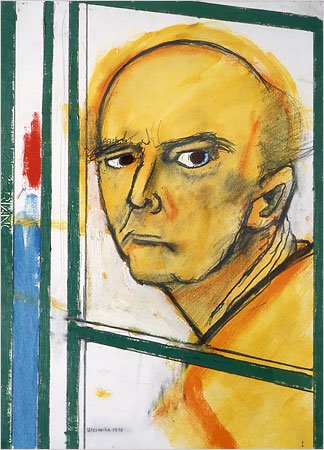
The Gray Lady has a fascinating article, complete with slide show, about artist William Utermohlen's documentation of his slide into dementia.
Sobering for all of us over-60 types.
October 23, 2006
On a Darkling Plain
If there is any time that calls for the clear sight of moral discernment, it is this moment. People are anxious, and they should be, because they are sensing the ubiquitous symptoms of a culture in decay. For centuries, the society of the Renaissance and the so-called "Reformation" has stood as an over-arching culture over Europe and the New World. But now, the energy of this culture is leeching [sic] into decadence, and the pillars of Church and the classic world are disappearing from view. Loyalties to society in general are giving way to liberation movements and interest groups. Violence and crime occur on the neighborhood level in too many neighborhoods, and too many of the victims are children. Governments are full of good intentions, but have less and less power to achieve them. Our economy is built on mass production, and we are required to consume in mass quantities. Self-discipline and respect are evaporating values, as our celebrities appear in ever-increasing levels of unkemptness, undress and disordered lives. In the arts, the hero has largely disappeared: literature is filled instead with characters possessed by self-loathing and a hatred of life. The visual arts have turned away from the sublime, and are now typified by Andy Warhol's minimalist definition: "Art is what you can get away with." Relationships are characterized now by demands and financial contracts, instead of commitment and joy. Too many children can now be described as "semi-orphan"--they are members of families with no stability, no rituals and customs, and not even a consistent set of parents.
* * * *
Is it not up to us, who are living at end of this civilization, to listen to Heaven enough, to witness its Vision, so that we can "know what is right" on this Earth?--Fr. John Tobias
"Foaming With Much Blood"
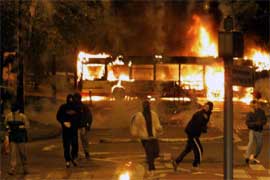 The indispensable Cap'n Ed observes the authorities' increasing loss of control over the French suburbs, inhabited by mostly North African immigrants and their children, and more and more "no go" zones for the police.
This cannot end well. Either Islam will dominate and dhimmify France, or an autoritarian government will impose assimilation on some, and emigration on others. A soft-landing is unlikely.
Enoch Powell was blunt but perhaps prophetic.
Subscribe to:
Posts (Atom)