 I'm not meticulous enough to do it, probably, but I love reading about it. Much more so than doing what many of my fellow middle-class, middle-aged, white male compatriots like--watching basketball on TV.
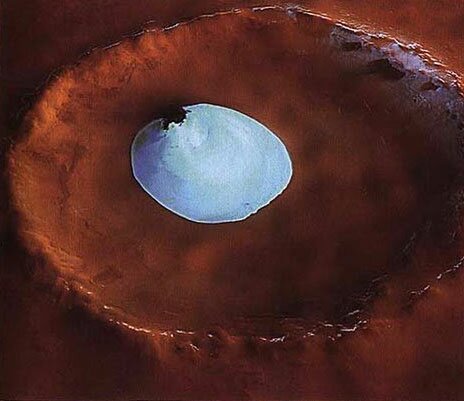
First, they've found enough water on the south polar icecap to cover the whole planet, although 90% of the water that used to be there seems to have disappeared. Liquid water is necessary for life as we know it, and there's probably some at the toe of the icecap:
I'd rather not meet any Martians, even if, as is probably the case, they're microbes. Remember what our microbes did to the Martian invaders in War of the Worlds."Life as we know it requires water and, in fact, at least transient liquid water for cells to survive and reproduce. So if we are expecting to find existing life on Mars we need to go to a location where water is available," Plaut said.
"So the polar regions are naturally a target because we certainly know that there's plenty of H2O there."
Some of the new information even hints at the possible existence of a thin layer of liquid water at the base of the deposits.
 They've recently released results from studies of pig DNA from around the Pacific. Pigs did not radiate out from Taiwan to Oceania, as the linguistic evidence suggests happened with the people. (There are, or used to be, several Austronesian languages on Taiwan that separated a long time ago, suggesting it as the point of origin.)
I've always been fascinated by domestication. It seems so improbable, except maybe for dogs domesticating themselves, yet apparently happened repeatedly, all over the world.The study is titled "Phylogeny and Ancient DNA of Sus Provides Insights into Neolithic Expansion in Island Southeast Asia and Oceania." Sus is the genus of pigs. Neolithic refers to Stone Age people who have developed agriculture.
Bollt says this does not mean the authors believe Polynesians originated or even visited Southeast Asia, or even that they necessarily sailed from Taiwan without pigs. They may have lost their pigs. They could have stopped at some point along what is now Vietnam and traded for or captured pigs, and then moved on, leaving no trace. Or perhaps the pigs were carried into the Lapita islands by other people, and the folks who would populate Polynesia picked them up there.
"It does support a more complex theory of migration that is not as linear as we've thought," Bollt said.
The paper suggests that there are other explanations than the popular "Speedboat out of Taiwan" theory, which argues that a single culture moved through Oceania, evolving as it went but without much outside influence. An alternative view is that there may be "multiple origins of the various cultural components," the paper said.