Here.
And the author is that Aussie idol-smasher, Keith Windschuttle.
June 9, 2005

June 8, 2005
The Bolivian Mess
The backsliding of a supposedly democratizing Latin America into a reflexive leftism is a neglected story. To be sure, there is Mad Hugo Chavez in Venezuela. But Lula in Brazil, Obrador in Mexico and others represent a less maniacal, less extreme leftism.
Latin America, of course, with the exception of Chile, never really accepted the concept of limited government and development of a market system. The encyclopedic European constitution, late and unlamented, finds its enacted echo in many Latin American countries. But the trend is away from free markets and limited government, toward a statism that in theory, at least, attempts to reduce inequality or at least to improve the lot of the poor -- usually with little success and much theft and demagogy.
Bolívia is something different -- a perpetually failed state, now sinking into anarchy, or at least civil war and partition. Here's an account by Augusto Nunes, a writer for Rio de Janeiro's Jornal do Brasil, the closest thing Brazil has to the Gray Lady. Translation by me, with apologies to Senhor Nunes for any errors and infelicities of expression.:
A failed state in the Andes is hardly a pleasing prospect, and one that neighbors, Brazil, Argentina, Perú and Chile are hardly likely to look on with favor. Look for Santa Cruz to contemplate autonomy or even secession, the Aymara and Quechua highlanders to follow one Pol Pottish rebel after another, and feral dogs to feed on the corpses.
It might as well be Chinatown.
Latin America, of course, with the exception of Chile, never really accepted the concept of limited government and development of a market system. The encyclopedic European constitution, late and unlamented, finds its enacted echo in many Latin American countries. But the trend is away from free markets and limited government, toward a statism that in theory, at least, attempts to reduce inequality or at least to improve the lot of the poor -- usually with little success and much theft and demagogy.
Bolívia is something different -- a perpetually failed state, now sinking into anarchy, or at least civil war and partition. Here's an account by Augusto Nunes, a writer for Rio de Janeiro's Jornal do Brasil, the closest thing Brazil has to the Gray Lady. Translation by me, with apologies to Senhor Nunes for any errors and infelicities of expression.:
Bolivian history is a series of irreparable defeats. In wars against its neighbors, failure has cost it, besides thousands of lives, the amputation of important territories. In internecine wars, native aristocrats associated with military chiefs invariably defeated the disarmed people -- and Bolívia was subjected to systematic and endless raids on its natural resources. The Republic, founded in 1825, in snow smaller, poorer, less stable, and more isolated than ever. And now it's mired in anothepoliticalal crisis, as has been happening for the last 180 years.Precolombian BolÃvia was of course a centralized state that has even been called "socialist", followed by a scarcely more democratic period of Spanish colonial rule. Other than ideas that may have been imported, there is little basis in history or culture for democracy, capitalism, or even honest government.
Defeated in the Pacific War, it lost to Chile, in 1884, the strategic access to the sea. In 1903, frontier disputes in the Amazon frontier led to a diplomatic war in which the Baron of Rio Branco, Brazil's Foreign Minister, easily prevailed. All he needed were many bribes and a few promises that were never kept -- the Bolivian branch of the Madeira-Mamoré Railroad, for example. The price was the annexation of what is now the state of Acre to the map of Brazil. A good deal -- for the Brazilians.
The third great fiasco would come in 1935, with the Chaco War. Before defeat came, Paraguayans and Bolivians traded lead in terrible but pathetic battles. Under the tutelage of foreign oil companies interested in the deposits in the Chaco desert, native warriors who only spoke their indigenous languages embarked for battle on board tanks they had never seen before the hour of battle. Crammed into armored vehicles, Paraguayans and Bolivians squandered bravery and ineptitude. Few learned how to drive that armored invention. Many died without having deciphered manuals published in English or Spanish. Bye-bye Chaco, bye-bye oil. Another loss among so many, to victorious and voracious neighbors.
The confiscation of many efforts and modernization was carried out by Bolivian billionaires rewarded, with the right to plunder without competition, exempt from taxes, mines unbelievably heavy with gold, silver and tin. In this field, none outdid the legendary Antenor Patiño, who wasted in Paris, the scene of movie festivals, the money he got plundering the mines of Bolivia. He rarely visited his native land. "I prefer Paris," he admitted.
"The Bolivian people is America's orphan," summarized the writer Augusto Céspedes, who died in 1998. "We survive with no relatives, without friendsrends, without allies or generous godparents. We are condemned to be alone." Today, as always lacking partners, Bolívia is trying to save the last economic gambit in sight: marketing natural gas on favorable terms.
For various reasons, it's a difficult struggle. Outside the country, it will have to outwit a huge and greedy neighbor -- Brazil, the main customer for Bolivian gas. On the internal front, an ancient threat still surrounds the lonely orphan: a dangerous geopolitical schizophrenia that divides the altiplano whose capital is La Paz from the lowlands of Santa Cruz province. In the world of Santa Cruz, the standard of living ishigherigheer and traditional families imitate the habits of exiled Spanish nobility. They want autonomy.
The Andean mountain dwellers, mostly dirt poor, are of indigenous origin, and have little money and decades of frustration. To anesthetize themselves and forget their hunger, they resort to the ancient coca-chewing habit. They cycle from apathy to rage in a few days (or hours). Lately tired of the resigning President Carlos Mesa, they have overthrown many officeholders.
In 1939, they withdrew the support they had provided two years previously to the young Col. German Busch and drove him to suicide. Busch's modernizing dreams, decorated with nationalist and leftist themes, encouraged the rise of Maj. Gualberto Villaroel, leader of the 1943 coup. That dream lasted three years.
With the support of drunks, beggars, petty criminals, hordes of the poor from the outskirts of La Paz marched on the Quemado Palace, ready to invade it. Céspedes, tghen an apprentice politician, witnessed the drama with a writer's eye. "The street people broke into the Palace, captured Villaroel, hung the President from a lamppost and beat him until he was reduced to a human paste," wrote Céspedes. "The next day, one could recognize only his green eyes. Light-eyed Bolivians are quite rare. As rare as periods of peace."
As rare as times of hope, such as they were. None lasted longer than that the Andean nation lived through from 1952 to 1964. This was the first term of Victor Paz Estensoro, leader of the Revolutionary Nationalist Movement (MNR), Bolivia's version of the Labor Party [of Brazil] in its origins. Tin mines were nationalized, legislative changes abolished ancient larcenies, and it seemed that Bolívia began to make out a path to the future. This hope went up in smoke with a military coup that ended the second term of an Estensoro already reduced to a hostage of uniforms and dollars.
From then until now, with a few democratic gasps, turbulence has routinely prevailed. The quick rotations of power would lead one to believe that the coup d'etat had become institutionalized as the way to change governments. The procession of general-Presidents includes oddball leftists like Juan Torres, ultrarightists like Hugo Banzer, traffickers like Garcia Meza. Even some honest people. None found a way out. Perhaps none exists.
A failed state in the Andes is hardly a pleasing prospect, and one that neighbors, Brazil, Argentina, Perú and Chile are hardly likely to look on with favor. Look for Santa Cruz to contemplate autonomy or even secession, the Aymara and Quechua highlanders to follow one Pol Pottish rebel after another, and feral dogs to feed on the corpses.
It might as well be Chinatown.
Don Corrado Prizzi -- VP of Syria?
I did a litle googling.
The character in Prizzi's Honor that looks like the Vice President of Syria, is Don Corrado Prizzi, played by a wonderful character actor named William Hickey.
See this post for comparison.
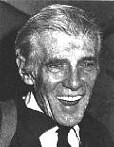
The character in Prizzi's Honor that looks like the Vice President of Syria, is Don Corrado Prizzi, played by a wonderful character actor named William Hickey.
See this post for comparison.
He Sat Next To Me On the Subway
 This guy, a naturalized American, crossed from Canada but was arrested in Massachusetts for a grisly Canadian murder.
Canada has some notorious mass murders. This guy looks about as odd as they come.
However, if he was a US citizen without wants or warrants, I guess they had to let him in.
Loud and Thunderous Applause
Wasn't the little guy on the right in Prizzi's Honor?

Update: see Don Corrado Prizzi here. Unfortunately, he's smiling, which is un-Baath-like and makes the comparison harder.
June 7, 2005
Swine
The Belmont Club documents the Cambodia-like insanity now prevailing in Zimbabwe.
Here is an account by a Dominican nun:
On Sunday evening I received one phone call after another saying "come quick they are going to kill us" - others would say "don't come you might be killed".Early on Monday morning I drove out to Hatcliffe, already in the distance I Could only see smoke rising up - nothing else. I arrived, I wept, Sister Carina was with me, she wept, the people tried to console us - they were aLL outside in the midst of their broken houses, furniture and goods all over the place, children screaming, sick people in agony. Some of the people who are on ARV drugs came to us and said we are phoning Sister Gaudiosa (Sister is doing the ARV programme) but she is not answering us, we are going to die". We explained that Sister was on Home leave but that we would help in whatever way we could.
It was a heartbreaking situation.The structures "mentioned above" that we the Dominican Sisters were working from were left untouched but had to be dismantled immediately otherwise They too would be destroyed. Sister Balbina from the House of Adoration came with carpenters and other staff members and started dismantling the structures.We are distributing all of them to people who have nothing, they will be OK if we leave them lying on the ground. Some friends arranged for a crane to come in to lift out two containers where we had medicine and food stored - it was one of the saddest days of my life.How does one say that Peter aged 10 and his little brother (John) aged 4 (not their real names) are "illegal". We had provided them with a wooden hut when their Mother was dying, she has died in the meantime, these two Little people had their little home destroyed in the middle of the night, we get there, they are sitting crying in the rubbish (that was their home until Sunday) - what do we do with them? They are only one example of the many vulnerable orphans whose little lives are destroyed.Veronica (not her real name) is an elderly widow who is chronically ill herself, she has 3 young grandchildren from her dead daughter - her home is destroyed. She is wearing a Rosary Beads around her neck, an apron with the picture of the Sacred Heart and a tee shirt with President Mugabe's photo - she has tried all means to survive!Some people came and said, "Sister there are two people who are dying, please come." One of them Mary (not her real name) who is out in the open all night lying on an old damp mattress can't move with pain, she has shingles, which is open and bleeding. What is worse her tears or her bleeding wounds?
I felt/feel paralyzed.Anne (not her real name) delivered a baby a week ago, she is Critically ill and is on the verge of death, what do we do with her? We give her pain killers, we give her blankets, we give her food (which she in unable to eat) - what is going to happen to her baby?
Not a peep from the human rights movement or the liberals.
Where is Mandela? Where is Mbeki? Where is Amnesty? International ANSWER? Where is the UN -- oh, that's right, the Cartel of Tyrants?
June 4, 2005
Another Poem by Zoë, 13
Here. Excerpts:
I cry because you’re how you are,
a slave to others, who are slaves to you.
The words you say can eternally scar,
I cry due to the things you do.
* * * *
I weep because I remember times,
when the young were really kids.
And distant from this world that grinds,
individuality down to all but what 'cool' forbids.
* * * *
So if you dare to ask me why,
as if you’re unrelated.
Then I’ll reply with a big sigh,
“for the world that those like you've so desecrated.”
As Glenn Reynolds would advise, "Read the whole thing."
Tut-Ankh-Cheesecake
 When Sizzler started decorating its restaurants in post-industrial style, I knew the soi-disant avant garde would have to go elsewhere for its stylistic kicks. Now Cheesecake Factory has been ransacking the past in post-modernist style for its décor, as in a neo-Pharaonic instance beautifully depicted here. I suppose the SDAG will now have to look to Cracker Barrel or Stuckey's for inspiration.
Photo credit and hat tip: Rick Lee the Magnificent (born in Babylonia, gone to West Virginia). Go look at his other photos, on this and other themes.
Another Nekkid Emperor(ress)(thing)
This piece puts in writing a thought I've had since I read about Harvard's allocation of $50 million to appease the diversity demonesses:
Every college in the country has been frantically pursing “diversity” in hiring and admissions for decades. The task force itself commends the diversity policies of 17 rival colleges—the mere tip of the iceberg—without drawing the obvious conclusion.
The second obstacle follows from the first: there is nothing more that can be done. If untapped pools of highly qualified female and minority candidates existed out there, schools would have snapped them up long ago—if not your college, then its dozens of competitors, just as desperate to placate the quota gods.
How many undiscovered sages with enough X-chromosomes or melanin are there out there waiting for the ferrets of Cambridge to find them? Couldn't poor, groveling Larry Summers put his hands through a buzzsaw and still have enough fingers to count them?
And we parents are supposed to find (or our children to borrow) tens of thousands of dollars to send our children to these citadels of idiocy!
There. So endeth my rant. Amen.
(Why don't I feel better?)
June 3, 2005
Two Takes On Schools And Teaching
One depressing and another transcendent.
Take your pick. Which is the trunk, and which the tail, of the elephant?
Documentation, Albeit One Sided . . .
. . . of the various nut jobs and "Earth Pigs" to be found in the Bay Area.
Fortunately, most of them don't breed.
June 1, 2005
Das Haus Ist Kaputt
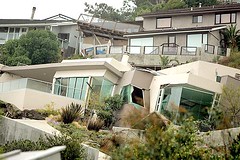
This sad pile of rubble is a multi-million dollar house that belongs to a client of mine. Built as a spec house, the project suffered many vicissitudes. I tried and won a case about the miserable work of the window subcontractor, and had a pending case about the concrete driveway. "Moot!" said Mother Nature, and it was so.
Fortunately, no one was there when it fell, and in fact apparently no one was seriously hurt.
Subscribe to:
Posts (Atom)